
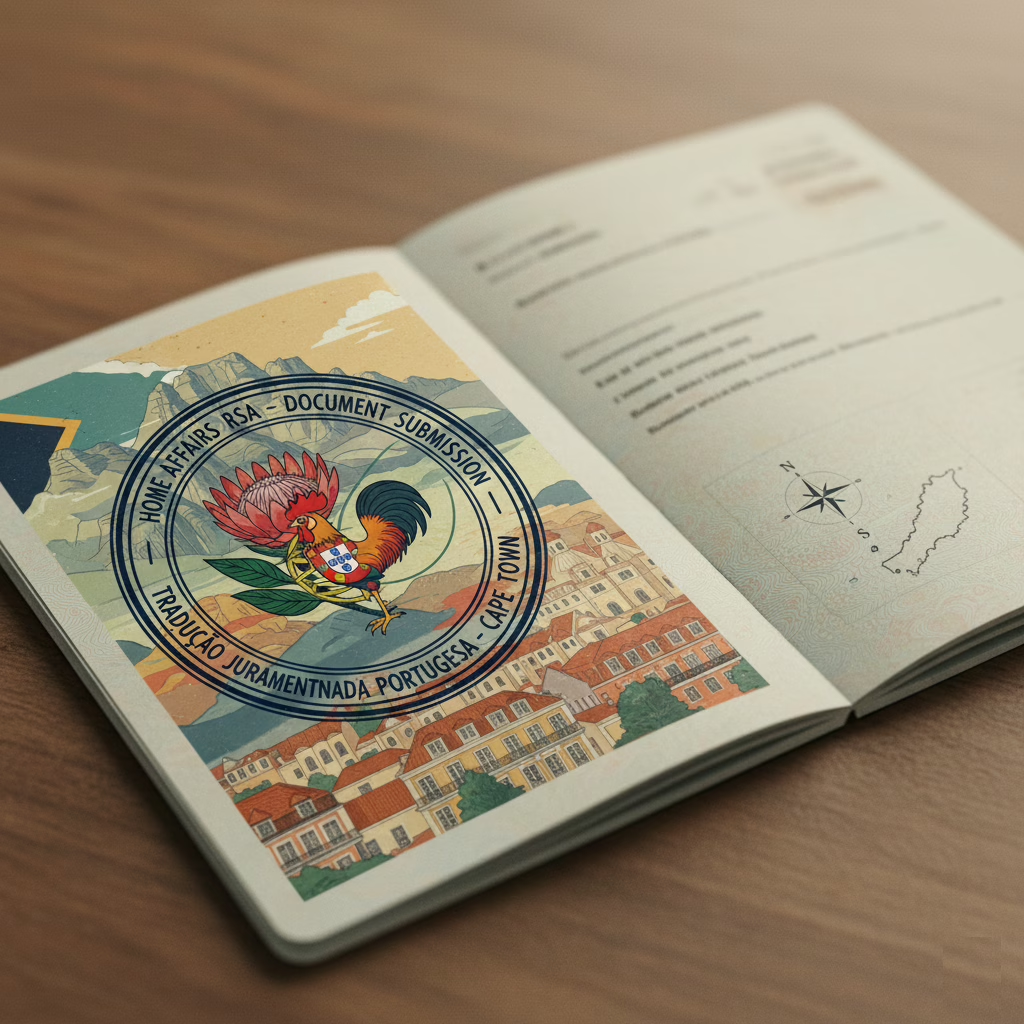
Portuguese Documents for Home Affairs
Cape Town’s identity is woven from a rich tapestry of cultures, and among its most vibrant threads is the Portuguese community. From the pioneering fishermen who settled in Woodstock in the 1930s, establishing an enclave that would affectionately become known as “Little Madeira,” to the significant waves of immigration from mainland Portugal and the former African colonies of Angola and Mozambique, the Portuguese-speaking community has become an indelible part of the city’s social and economic fabric. Today, with estimates suggesting that Portuguese South Africans constitute a significant portion of the white population, their presence is felt across every sector, from commerce and industry to science and the arts.
The letter of the law: how Home Affairs treats foreign documents
Home Affairs and its partners apply a simple rule. If a document is in a language other than English, the application must include an official English translation. Applications with untranslated or improperly translated documents are treated as incomplete and are not processed. In practice, this requirement appears on checklists across visa, permit, and permanent residence categories, including those administered through VFS Global.
What “sworn translation” means in South Africa
A sworn translation is more than a good translation, it is a legal instrument. A sworn translator is authorized by the High Court of South Africa after demonstrating competence and taking an oath to translate faithfully and correctly. Their translations are accepted as the legal equivalent of the original for evidentiary purposes.
How to recognize an authentic sworn translation:
- Official stamp or seal, uniquely identifying the translator.
- Translator’s signature on every page.
- Certification statement, for example, “true translation of the original”.
- Full translator details, including name, sworn‑translator designation, and language pair.
What it is not: a regular translation stamped at a police station, by a commissioner of oaths, or by a general practitioner or attorney. Those documents do not meet DHA’s sworn standard.
Why the sworn standard exists
Authenticity and fraud prevention: sworn translators reproduce layout, stamps, seals, signatures, and marginal notes, so officials can compare the translation with the original.
Legal integrity and accountability: decisions about visas and status have lasting legal effects. A sworn translation carries legal status, and the translator accepts professional responsibility for accuracy.
Administrative efficiency: one clear standard avoids case‑by‑case quality debates and keeps applications moving.
The high cost of cutting corners
Using an uncertified translator or self‑translating may seem cheaper at first, but it often produces the most expensive outcome. Common consequences include:
Rejection and resubmission: the application is marked incomplete, fees are forfeited, and timelines slip by weeks or months.
Inaccuracies that create red flags: name spellings, date formats, and legal terms must match precisely. Errors can trigger additional scrutiny.
Serious findings: where errors or irregularities affect outcomes, authorities may treat them as misrepresentation. The risk includes withdrawal of status and possible bans.
How to obtain a sworn Portuguese translation in Cape Town
Premium Lingua specializes in sworn Portuguese to English translations that meet DHA standards.
Our assurances
- Only High Court-sworn translators.
- Professional affiliations, including membership in recognised industry bodies.
- Precise reproduction of official features and formatting.
How the process works
Request a quotation: send clear scanned copies of your Portuguese documents. Pricing is usually per page or per word, depending on layout and complexity.
Translation and verification: we translate the content, reproduce the layout, and ensure all seals, stamps, and marginalia are captured.
Delivery: you receive physical hard copies with original ink signatures and embossed seals. Digital copies alone are generally not sufficient for submission.
Checklist and preparation
Use this list to reduce delays and resubmissions:
- Confirm whether the original document needs an Apostille before translation, especially for civil status documents issued abroad.
- Provide complete, legible scans. Include both sides if there are stamps on the reverse.
- Share any preferred spellings of names, as they appear on passports and past DHA records.
- Align dates with the South African format used in your application. If in doubt, ask us to match the format on the relevant DHA form.
- Plan for lead times when multiple documents or older civil records are involved.
Essential Portuguese documents and their sworn‑translation requirements
| Document Type | Commonly Required For | Key Requirements |
|---|---|---|
| Unabridged Birth Certificate | Relative’s visa, spousal visa, permanent residence, child’s first passport | Should include both parents’ details. Attach the sworn translation to a certified copy of the original. Required for all dependent children. |
| Marriage Certificate | Spousal visa or permit, permanent residence (section 26b) | If issued in Portugal, Angola, or Mozambique, the original may require an Apostille before translation. Translate the full certificate. |
| Divorce Decree | Spousal applications where previously married, permanent residence | Must be a final order. Translate all pages, including court stamps and signatures. |
| Police Clearance Certificate | Work visas, permanent residence, long‑term study visas | Needed for every country where the applicant has lived 12 months or more since age 18. Usually must be less than six months old at submission. |
| Academic Diplomas & Transcripts | Critical Skills, General Work, Study | Two steps: SAQA evaluation of the qualification, plus a sworn translation of the original diploma and transcript. Submit both the originals and translations. |
| Medical & Radiological Reports | Most long‑term visas and all permanent residence categories | DHA medical forms are typically in English. Any supplementary reports from a Portuguese‑speaking doctor must be accompanied by a sworn translation. |
Conclusion: Your Investment in a Smooth Journey
For any member of Cape Town’s vibrant Portuguese community embarking on the process of applying for a visa, permit, or citizenship in South Africa, the path is paved with detailed requirements and strict legal formalities. As this guide has demonstrated, the mandate for a sworn translation of all foreign-language documents is not a minor detail or an optional extra; it is a fundamental, non-negotiable legal prerequisite for a valid application.
The Department of Home Affairs’ regulations are consistent and unyielding: a document in Portuguese must be accompanied by an English translation that bears the official stamp and signature of a translator sworn in before the High Court of South Africa. This standard is in place to guarantee authenticity, ensure legal integrity, and prevent the severe consequences of non-compliance which range from costly delays and outright rejections to, in the worst cases, findings of misrepresentation that can jeopardize one’s entire future in the country.
Therefore, the decision to engage a professional, accredited sworn translator should be viewed not as an expense, but as the first and most critical investment in the success of your application. It is the definitive step you can take to ensure your documents are accepted without question, providing a solid and trustworthy foundation for the DHA to assess your case. By securing the official seal of approval from a sworn translator, you are ensuring a smoother, more predictable, and ultimately successful journey through the complexities of the South African immigration system. Premium Lingua is here to be your trusted partner on that journey.