
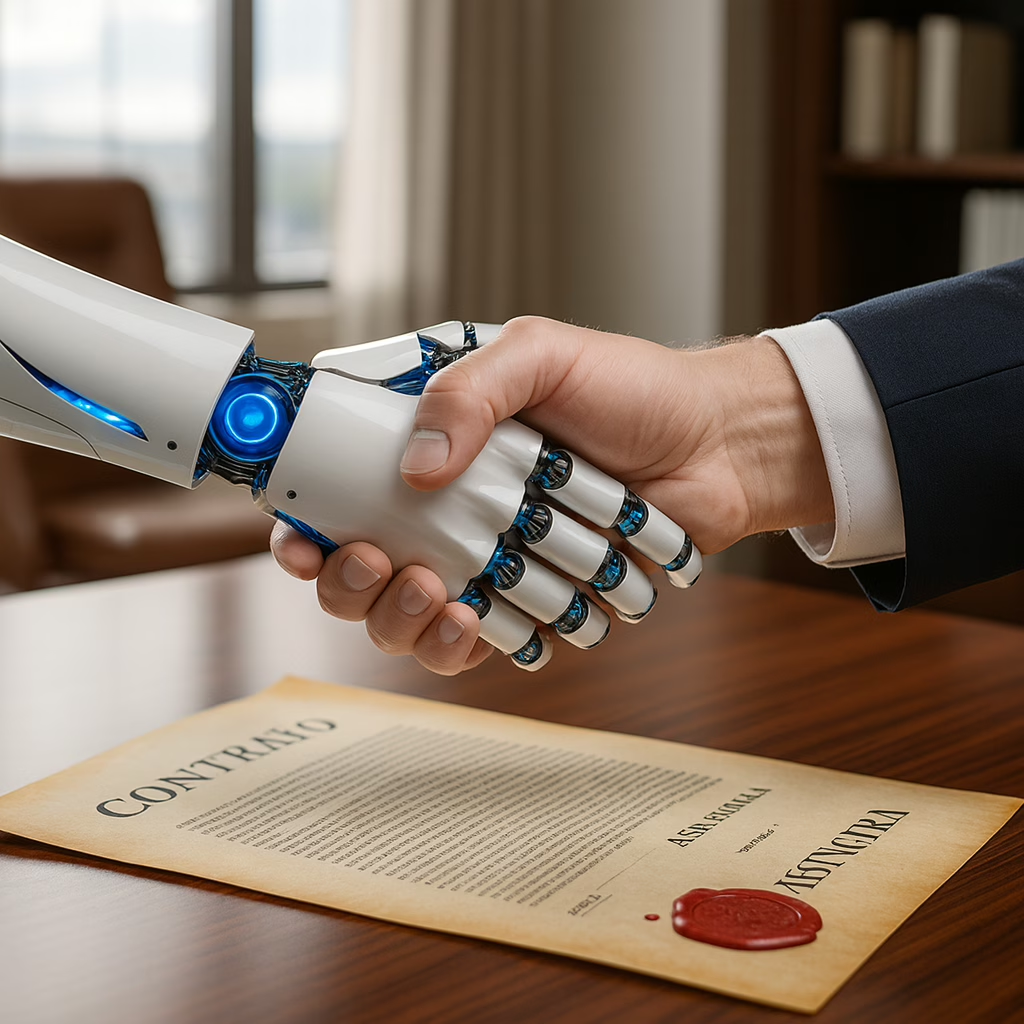
In an era of instant solutions, the appeal of using fast, cheap machine translation for legal documents is undeniable. For businesses, especially South African companies engaging with key partners in Angola and Mozambique, using AI to translate a contract or court document can seem like a smart, cost-effective shortcut.

But this shortcut is a minefield. While AI is a powerful tool, relying on it for high-stakes Portuguese legal translation isn’t a calculated risk. It’s a profound liability. The nuanced, jurisdiction-specific world of legal language demands a level of precision, legal reasoning, and cultural understanding that today’s algorithms simply cannot provide.
This is a deep dive into why a human expert isn’t just a better option; it’s the only option when legal integrity is on the line.
For contracts, court papers and compliance files, see our legal translation services.
The High-Stakes World of Portuguese Legal Translation
The Principle of Absolute Fidelity
Legal translation isn’t about conveying the general “gist” of a document. Its goal is to achieve legal equivalence, meaning the translated document must have the exact same legal effect in the target country as the original. Legal language is a precision instrument where every word, clause, and comma is deliberately chosen to define rights and obligations. Any deviation isn’t just a linguistic slip-up; it’s an erosion of the document’s legal power, potentially rendering it unenforceable.
This is especially complex because legal systems, like common law and the civil law systems used in Portugal and Brazil, are built on different foundations. A translator’s job isn’t a word-for-word swap but a search for the correct functional equivalent within a completely different legal framework. This requires deep legal reasoning, not vocabulary alone.
The Domino Effect of a Single Error
A legal document is a tightly woven system. One mistake doesn’t exist in a vacuum; it can trigger a catastrophic domino effect that unravels the entire agreement. This risk applies to a huge range of critical documents:
- Cross-border Contracts: Mistranslating a single financial term: like confusing “net revenue” with “gross revenue”: can alter every payment clause, liability cap, and termination condition, sparking million-dollar disputes.
- Patent Filings: An imprecise technical claim can narrow intellectual property protection or even invalidate the patent in a new market, destroying a company’s most valuable asset.
- Immigration Filings: A wrong date on a birth certificate or a mistranslated name can lead to immediate rejection, causing profound personal hardship, family separation, and lost opportunities.
The risk isn’t linear; it’s exponential. A small mistake has an amplified impact across the entire legal structure of the document.
The Cost of Getting It Wrong
The fallout from an inaccurate legal translation is devastating, hitting three key areas:
- Legal Consequences: Inaccurate translations can get evidence thrown out of court, invalidate contracts, and expose a business to fines and legal action for non-compliance with local regulations.
- Financial Consequences: The costs are huge, from litigation and dispute resolution fees to lost investments and international deals. One documented case saw a free trade agreement withdrawn due to “translation blunders,” costing an entire nation significant opportunities.
- Reputational Consequences: Inaccurate legal documents signal a lack of diligence and professionalism. They erode trust with international clients and partners, and the damage to a company’s global image can be permanent.
The Siren Song of Automation: Why AI Fails in Law
The Allure of “Good Enough”
The speed and low cost of tools like Google Translate are incredibly tempting. They foster a mindset of “good enough,” where convenience is prioritized over the catastrophic risks that are harder to quantify. Decision-makers often misclassify legal translation as a simple administrative task instead of what it is: a highly specialized professional service integral to risk management. This is a critical error in judgment that sets the stage for failure.
Statistical Patterns vs. Legal Reasoning
To understand why machine translation (MT) is unfit for legal work, you have to look at how it “thinks.” Neural Machine Translation models aren’t reasoning entities; they are incredibly sophisticated statistical pattern-matchers. They’ve been trained on billions of texts to predict the most likely sequence of words.
An AI doesn’t understand the meaning of a contract clause any more than a calculator understands calculus. It just runs an algorithm.
A human expert, on the other hand, engages in legal reasoning. They interpret the text within the context of legal precedent, legislative intent, and the specific legal systems involved. They recognize strategic ambiguity and make informed judgments when a direct equivalent doesn’t exist. MT is context-blind, and statistical probability is a dangerously poor substitute for legal judgment.
The Myth of “Legal AI”
New “legal-specific” AI tools have emerged, trained on legal documents to improve terminology. However, they don’t overcome the fundamental problem: they’re still pattern-matching systems that can’t reason. Worse, they can be hyper-specialized, a tool trained on contract law might fail spectacularly when translating a patent application.
The proper role for AI in legal translation is as a support tool, not a substitute. It can help with first drafts for internal review or check for term consistency. But the final, authoritative translation of any document with legal weight must be performed, or at minimum meticulously reviewed and certified, by a qualified human professional.
When Algorithms Falter: Documented Failures of AI
Real-World Evidence of Inaccuracy
The risks aren’t just theoretical. A landmark study found that machine-translated legal texts contained critical errors in 38% of samples, including mistranslated clauses and the complete omission of liabilities.
A powerful cautionary tale comes from the 2024 case Snell v. United Specialty Ins. Co. A litigant used a Generative AI tool that “hallucinated” and fabricated multiple legal citations, including non-existent court cases with fake quotes. The court dismissed the claims and issued a stern warning against using AI-generated fictions.
This highlights a unique danger of modern AI: its ability to generate content that looks plausible but is entirely false.
The Black Box of Confidentiality
Using free, public MT platforms for legal documents is a grave security threat. When you paste text into these tools, you lose control over it. Their terms of service often state that your data can be stored and used to train their AI. This has massive implications:
- Breach of Attorney-Client Privilege: Submitting confidential client data without consent can breach one of the most sacred duties in law.
- Violation of Data Protection Laws: This practice can violate strict laws like Europe’s GDPR, leading to multi-million-dollar fines.
- Exposure of Intellectual Property: Translating merger agreements or patent drafts on a public tool is like handing your trade secrets directly to a third party.
Professional translation services are bound by legally enforceable non-disclosure agreements (NDAs) and use secure, encrypted systems. This is a safeguard that public MT platforms simply do not provide.
The Inability to Handle Nuance
AI’s most subtle failures lie in its inability to grasp nuance. For example, the Portuguese pronoun sua can mean “his,” “her,” “its,” or “your.” An AI’s incorrect guess in a contract could fatally confuse property ownership. Similarly, AI can “correct” intentionally ambiguous language used for strategic purposes in negotiations, thereby altering the document’s legal intent without the user even knowing.
| Feature | Machine Translation (AI) | Human Expert Translator |
| Accuracy & Fidelity | Based on statistical probability; a study found critical errors in 38% of MT legal texts. | Focuses on achieving legal equivalence, ensuring the same legal effect as the original. |
| Legal Nuance & Context | Lacks understanding of legal precedent, jurisprudence, or the intent behind clauses. | Possesses deep knowledge of both source and target legal systems and concepts. |
| Handling Ambiguity | Struggles with pronoun resolution and often incorrectly “clarifies” strategically ambiguous language. | Capable of discerning and preserving intentional ambiguity; uses expert judgment. |
| Jurisdictional Adaptation | Cannot reliably adapt to critical differences between European and Brazilian Portuguese. | Specializes in the target jurisdiction, ensuring correct terminology and formatting. |
| Confidentiality & Security | High risk. Free tools may use submitted data for training, breaching privilege and violating data protection laws. | High security. Operates under legally binding NDAs and uses encrypted systems. |
| Legal Accountability | Offers no legal accountability and cannot provide legally required certifications. | Provides full accountability and can deliver legally recognized certified or sworn translations. |
The Human Imperative: Judgment and Jurisprudence
A professional legal translator is more than a linguist; they are a legal-linguistic specialist. Many are former attorneys or hold advanced law degrees, giving them the dual expertise needed to navigate complex legal concepts between different legal traditions.
They are also guardians of intent and tone. In a legal brief, word choice is strategic and persuasive. In witness testimony, tone and hesitation are crucial for credibility. An AI processes text as data; a human understands and preserves these vital qualitative elements.
Ultimately, hiring a professional is an act of risk management. It creates a defensible audit trail showing you took reasonable steps to ensure accuracy. The fee isn’t just a cost; it’s an investment in legal defensibility, regulatory compliance, and insulating your business from catastrophic risk.
The Lusophone Labyrinth: European vs. Brazilian Portuguese
A common and dangerous mistake is treating “Portuguese” as a single language. European Portuguese (spoken in Portugal, Angola, Mozambique) and Brazilian Portuguese are distinct standards with significant, legally relevant differences in vocabulary and grammar.
Since Brazil has the majority of Portuguese speakers, most MT training data is overwhelmingly Brazilian. This means an AI translation for use in Portugal or Angola will almost certainly be unnatural, incorrect, and legally imprecise.
The Vocabulary Minefield
The danger lies in “false friends”, words that look the same but have drastically different meanings.
- The word propina in Portugal means “university tuition fee.” In Brazil, it means a bribe or kickback. Submitting a financial document in Brazil using this term could trigger a criminal investigation.
- Apelido means “surname” in Portugal but “nickname” in Brazil, a difference that could invalidate any document requiring formal identification.
These aren’t subtle nuances; they are fundamental differences an algorithm can’t reliably navigate.
A South African Perspective: Engaging with Lusophone Africa
For South African businesses, this distinction is critical. Angola and Mozambique are key economic partners where Portuguese is the sole official language for contracts and court proceedings. A South African company entering these markets cannot use a generic or Brazilian Portuguese translation. Success requires legal documents precisely tailored to the specific variant of Portuguese recognized in that country, a task only a human specialist can perform.
| Term | Meaning in European Portuguese | Meaning in Brazilian Portuguese |
| Propina | University tuition fee | Bribe, kickback |
| Apelido | Surname, family name | Nickname, cognomen |
| Fato | A man’s suit (formal wear) | A fact, an occurrence |
| Coima | Administrative fine (legal term) | (Not used) |
The Seal of Authenticity: Certified and Sworn Translations
Official bodies like courts and government agencies don’t accept just any translation. They require an official translation with a formal declaration of accuracy. The rules for this vary dramatically between jurisdictions.
- Portugal: Uses a system of certified translation (tradução certificada). A qualified translator must have their work certified by a notary, lawyer, or solicitor, who affixes their official seal.
- Brazil: Operates a much stricter system. Legal documents must be translated by a sworn translator (tradutor juramentado), a state-appointed professional who passed a competitive public exam. Their translations are official documents by definition and require no further notarization.
- Angola & Mozambique: Have their own distinct requirements, often involving authentication by their respective embassies or consulates.
The South African Process for International Legalisation
For a South African company preparing documents for use in Angola or Mozambique, the process is multi-layered and must be followed exactly:
- Sworn Translation: The document must first be translated by a sworn translator certified by the High Court of South Africa.
- High Court Authentication: The Registrar of the High Court then verifies the translator’s signature and seal.
- DIRCO Authentication: The document must then be authenticated by the Legalisation Section of the Department of International Relations and Cooperation (DIRCO).
- Embassy Attestation: Finally, since neither Angola nor Mozambique is part of the Hague Apostille Convention, the document must be taken to the respective country’s embassy for a final attestation.
Failure at any of these steps can render your document invalid, causing major delays and legal headaches.
The Final Verdict: Your Only Defensible Choice
The evidence is overwhelming. For any document where rights, obligations, or legal standing are at stake, using unverified machine translation is not a calculated risk. It is an act of professional negligence.
The only responsible and defensible choice is to engage a qualified human expert. The nuances of legal language, the complexities of comparative law, and the absolute requirement for precision are domains where human intellect and judgment remain irreplaceable.
For your business, investing in professional Portuguese legal translation is a strategic imperative. It is a core component of risk mitigation, legal compliance, and successful global operations. In the high-stakes world of international law, precision isn’t a luxury. It’s everything. And a human expert is your sole guarantor of that precision.